
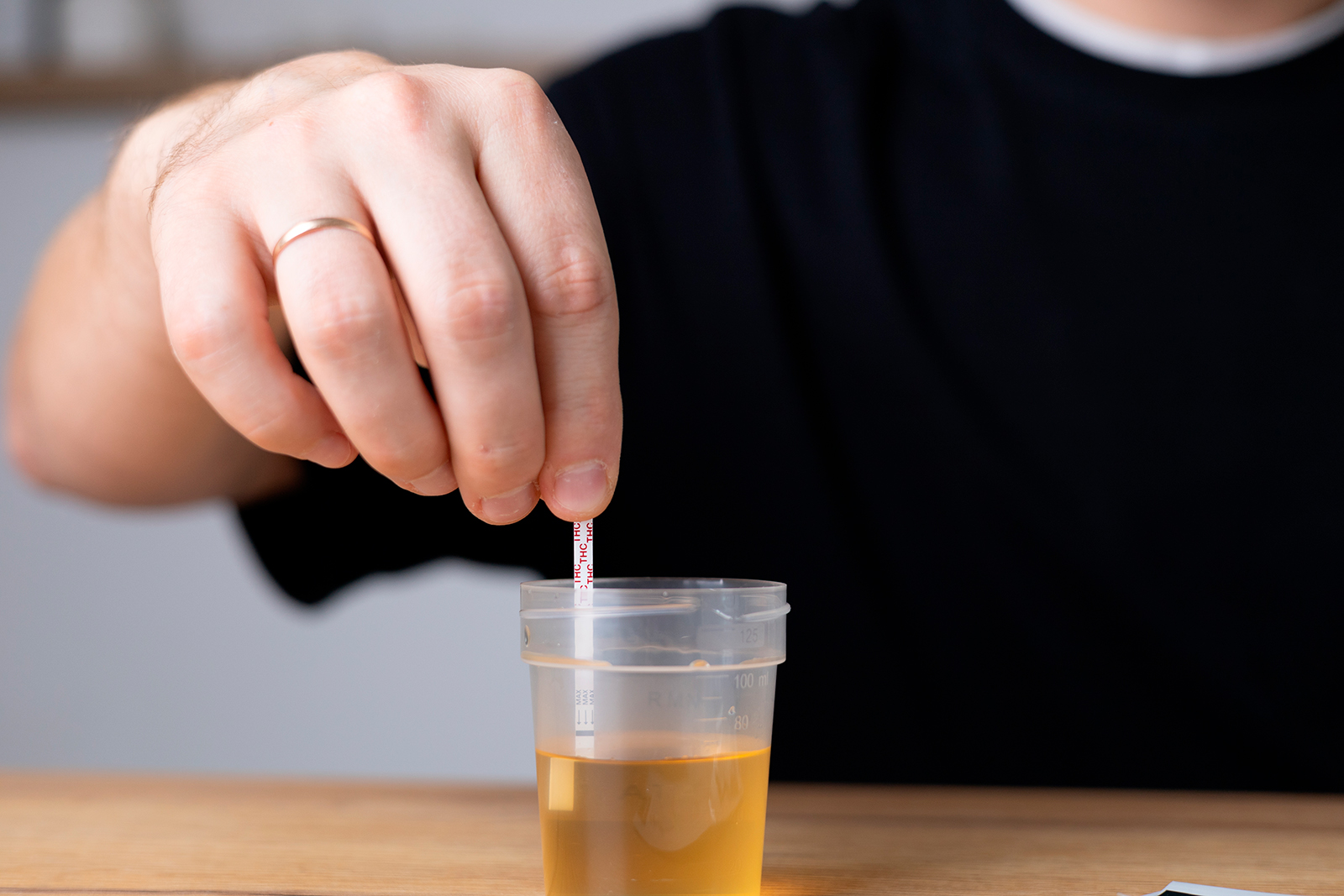
Once people get an official drug test date, the anxiety sets in, and the search for a cleansing solution begins.
The internet made a lot of useful info available, yes, but it also gave way to a lot of myths, especially when it comes to getting rid of THC quickly. The harsh truth is that, due to its nature, THC cannot be eliminated overnight, especially after periods of prolonged or heavy use, or both.
But there are things to do to chase the drug test anxiety away. Knowing where you stand, what to avoid, how the metabolites are processed, and which organ is key to detoxing – that’s what we are going to talk about.
First Off, What A Urine Drug Test Is Actually Looking For
A lot of people assume that a urine drug test is designed to detect THC directly, and by extension, cannabis-induced impairment. But, that is far from the truth.
Both lab and at-home urine drug tests are engineered to look for metabolites that remain in the body after using, aka THC-COOH. This metabolite has a tendency to pile up in fat tissue, and by its own nature doesn’t have the psychoactive effects.
So, to put things bluntly, a urine drug test cannot tell if you used recently (smoke, vape, or edibles). Only oral swabbing and blood test can detect that, with a very narrow detection window (both are rare). But it can tell whether or not you used frequently in the past, based on metabolite accumulation.
Most tests are not even designed to tell how much of these metabolites exactly are in the system. They test to see whether the levels are below or above a predetermined cutoff (aka threshold). The first (screening) test is most likely to be at 50 ng/ml (nanograms per milliliter), and if that rings positive (above the cutoff), the confirmatory test is conducted at a lower cutoff.
Why THC can’t be flushed away
As mentioned above, THC metabolites have a tendency to accumulate in body fat. That happens because, unlike almost every other substance, it is fat-soluble. Right away, this tells us that chugging down copious amounts of water will not help. The metabolism of THC actually goes like this:
- It enters the body (absorption) and gets into the bloodstream (immediate psychoactive effect)
- Then, it gets quickly distributed into fatty tissues, but also the brain, liver, and visceral fat
- The liver kicks in, using enzymes to metabolize the THC, eventually turning it into THC-COOH, which the tests are designed to detect
- Excess metabolites start accumulating in body fat, especially with frequent use
- Body slowly starts eliminating the metabolites (mostly through feces, and some amount through urine)
The last, and most important step, is dictated by the speed of metabolism, which is different for everyone, and governed by the liver as the main player.
What Quick “Detox” Drinks and Methods Really Do
A plethora of detox drinks promise a clean result in 24 to 48 hours. But they do not rely on supporting the last step (elimination). Instead, what these “magical potions” do is urine dilution. At its core, these methods only mask the presence of THC metabolites in urine for a narrow window of a few hours, with often unpredictable results.
Another popular detox method is crash diets, in combination with excessive amounts of creatine and vitamin B. Both of these popular supplements are there to hide the fact that the urine is diluted, because modern labs can easily detect that something is wrong.
So, in short – detox drinks and quick-fix supplements are not designed to support the liver and the THC elimination stage. Instead, they dilute the urine and try to hide it.
Lastly, and most risky, is urine sample tampering. People put vinegar, peroxide, or other common household chemicals to try and hide the metabolites.
The truth is, all of these methods are regularly checked by the labs through specific gravity, creatinine levels, and pH level measurement. And once they discover that there was meddling with the sample, they will flag it as such, which can lead to other, more serious approaches to the whole process.
What You Can Actually Do To Help Your Own Detox Champion
It’s understandable that people, out of panic or anxiety, reach out for all sorts of solutions that are based in myth, rather than science. All of these methods promise quick results, usually without any explanation.
But there are things you can do to help your body (and more importantly, your liver) to eliminate the excess metabolites:
- Abstinence – stop using as soon as you find out you have a test scheduled
- Regular hydration – do not overhydrate (remember, dilution is not the answer)
- Support your liver with the right THC detox supplement that does not promise instant results
- Fiber-rich foods – remember that most of these metabolites go out through bowel movement
- Physical exercise – to promote metabolism, not burn fat necessarily. So, don’t overdo it
- Stop drinking alcohol – your liver only has enough bandwidth to metabolize the substances that enter the system, and alcohol takes a lot of it
Know Where You Stand
THC detection timelines vary from person to person, and there are no two human beings who eliminate them at the same rate. People who use THC products frequently, and/or in large quantities, can accumulate so much that their detox journey can last for months.
But there’s a way to know how the detoxification process is going — you test yourself at home. A 3-level at-home THC urine test will tell you where you stand. It measures your metabolites at 100, 50, and 20 ng/ml.

The highest cutoff is easy to pass, since that amount of excessive metabolites goes down in a few days. But the 50 and 20 ng/ml take some time and lifestyle changes, as your liver needs room to metabolize all the accumulated metabolites.
Avoid “Magical Potions” and Set Realistic Expectations
Again, it is only human to look for a quick solution to an anxiety-inducing problem. But the very nature of THC metabolites doesn’t allow for that. No drink or supplement will help you eliminate the extra built-up THC-COOH. These common myths only try to deceive the test, which modern labs expect, and are prepared for.
So, take your time. Find out where you stand by testing at home, start exercising and hydrating normally, and support your liver in doing what it does best — detoxification.
 Spot an error in this article? A typo maybe? Or an incorrect source? Let us know!