

If you’ve ever wondered whether your daily walk delivers the same health benefits as a quick jog, researchers now have numbers—and they’re quite different from what we’ve been told.
A new study tracking more than 73,000 adults has challenged the long-standing belief that one minute of hard exercise equals two minutes of easier movement. The real numbers paint a very different picture and here’s what I have understood from the study.
The Old Rule Needs Updating
For years, health authorities have promoted a straightforward exchange: can’t manage 75 minutes of hard activity each week? Just do 150 minutes of gentler movement instead. This two-for-one swap made sense because intense activities burn about double the energy of gentler ones.
But this exchange rate came largely from people filling out forms about their exercise habits, not from tracking actual movement. When scientists used devices to monitor how people really move, they discovered something else entirely.
Related » The Hidden Health Crisis Hitting Men in Their 30s
What the Numbers Actually Show
Researchers followed participants for roughly eight years, tracking outcomes such as mortality, cardiovascular events, diabetes, and cancer. What they found: one minute of hard activity equals somewhere between 4 and 9 minutes of moderate movement, depending on which health benefit you’re measuring.
To lower the risk of early mortality, one minute of running or hard cycling matches about four minutes of brisk walking. For cardiovascular protection, the exchange stretches to nearly eight-to-one. For type 2 diabetes, it’s closer to nine-to-one. The exact number shifts with the specific health outcome—but across the board, the real ratios are far steeper than the old 1:2 rule.
Gentle activity—slow walking, light housework—lags even further behind. Depending on the condition being measured, you’d need somewhere between dozens to over a hundred minutes of gentle movement to match what one minute of intense effort delivers. And for several health outcomes, increasing gentle activity didn’t show strong or consistent protection in the first place.
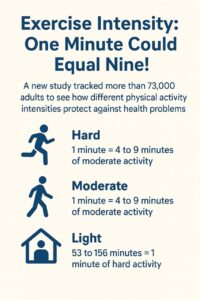 Exercise Intensity Matters
These figures tell us something significant: hard exercise is considerably more effective per unit of time than anyone realized. If your schedule is tight, brief periods of effort deliver more protection than earlier estimates suggested.
But what I find worth noting is that the researchers aren’t telling everyone to become endurance athletes. They found that even small amounts of vigorous activity—accumulated over time, a minute here and a minute there—add up meaningfully.
The Limits of Gentle Movement
The study revealed that gentle activity, while far better than being sedentary, has its limits. It doesn’t provide the same disease protection that moderate or hard activity offers, even when the total time spent doing it is very high.
Does this mean your evening walks are useless? No, but it does mean that if you’re aiming for the strongest long-term protection against major diseases, you’ll need to occasionally nudge yourself into a higher intensity.
Related » The Correct Way to Warm Up Before a Workout
What This Means for Your Wearable Devices
Most fitness trackers already award different scores to different movement intensities. But many of these systems are still built on older, questionnaire-derived assumptions about how intensity translates into health benefits.
This new evidence suggests those calculations may need revision. If you’re someone who monitors daily steps or activity points, it might be worth paying a bit more attention to effort level, not just quantity. A brief burst of hard work could be worth far more than you imagined.
The Research Details
The study examined adults between ages 40 and 69 in the UK. Scientists excluded people who already had the conditions being measured and waited a full year before counting any new health issues to avoid confusing cause and effect.
What strikes me as significant is that this work used direct tracking, not recall or guesswork. Participants wore devices that recorded their movement continuously in brief intervals. This degree of accuracy wasn’t available with paper surveys.
It’s worth noting that the findings show associations over several years; they don’t prove causation. But with such a large sample and objective measurement, the patterns seem compelling.
My Conclusion: It’s Time to Tweak Your Workouts
You don’t need to quit your walks. But if you’re walking for health improvements, consider raising your speed now and then. Find some inclines. Add a short jog. These minor adjustments may deliver benefits far beyond the extra effort involved.
The study doesn’t claim hard exercise is superior in every possible way. It simply shows that intensity matters more than we understood—and that even small doses, built up over time, can produce substantial results.
The research appeared in Nature Communications and examined 73,485 participants monitored for approximately eight years.
 Spot an error in this article? A typo maybe? Or an incorrect source? Let us know!