
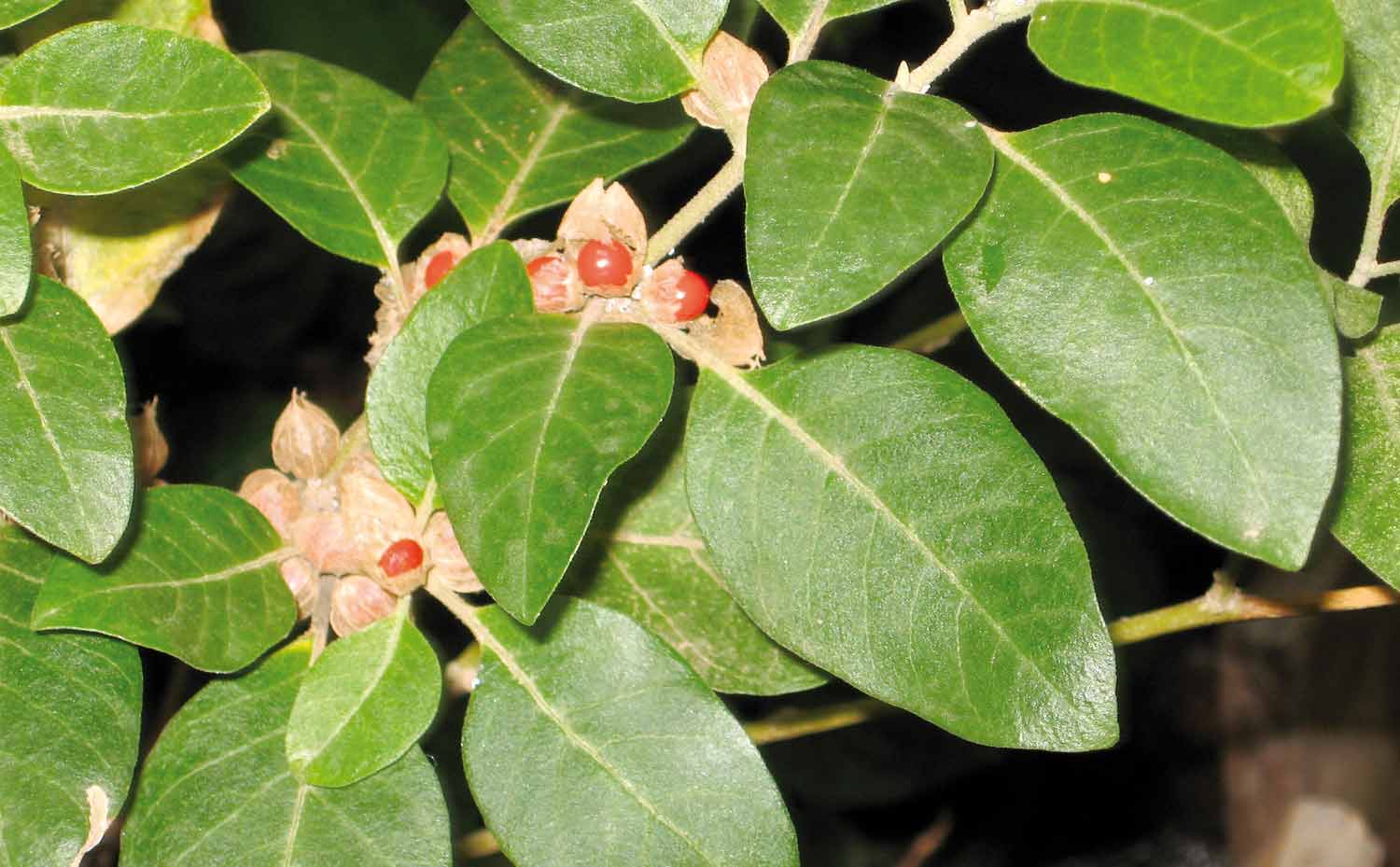
Ashwagandha, also known as Indian ginseng, is a plant from the solanace [nightshade] family. It is known for promoting vigour and vitality. That is not all – it also heals the mind and body. An antioxidant, adaptogenic [having cabability to increase body’s resistance to stress], aphrodisiac, anti-inflammatory, sedative, mood elevator… the list of benefits goes –on. Ashwagandha has been advocated as a general energy-promoting, disease-preventing tonic due to its effect on the immune system. Globally, people of all ages and sex have been advised this root since times immemorial.
More about the plant
A branched, evergreen erect shrub grows up to a height of 0.3-1.5 m. Leaves are egg shaped. Flowers are hermaphrodite [having both male and female reproducing parts] and are greenish or lurid yellow in colour, about five together in an umbellate cyme. Its fruit [berries] are orange-red in colour. Its roots are whitish-brown in colour. This is a small woody shrub that flowers all the year round.
The estimated production of Ashwagandha in India is more than 1500 tonnes and the annual requirement is about 7000 tones. This makes an increase in its cultivation and production a crucial issue. It grows in India, Sri Lanka, and Pakistan.
Did you know?
- Studies on this herb have proved that aging can be slowed; haemoglobin and calcium levels can be increased and the sexual performance be enhanced. [The European Journal of Herbal Medicine. 1998, Vol. 4, Issue 2:17-22]
- A double-blind study in India, on children aged 8-12, studied the effects of 2g of this root daily, for sixty days. Body weight, mean red blood cells, haemoglobin and grip strength were significantly improved.
The healing properties of Ashwagandha
Listed below are a few healing properties of Ashwagandha
Stress
Clinical and experimental studies have observed that Ashwagandha acts as an anti-stress and adaptogenic herb. It can be taken with milk, either alone, or with liquorice [legume related to beas and peas] to reduce stress.
Insomnia
The root is narcotic, induces deep sleep and hence beneficial in treating insomnia. The powder of Ashwagandha root when taken with bramhi or jatamamsi, gives excellent results for insomnia and is non-addictive.
Digestive problems
The root of this herb is used for treating digestive disorders like dyspepsia and loss of appetite. It corrects the disorder and restores normalcy in the system. It can be taken with ginger or pepper.
Cold and cough
Ashwagandha is beneficial in the treatment of chest diseases such as cold and cough. The root can be taken either in the form of powder or decoction. Berries and seeds can also be taken for chest complaints, with beneficial result.
Eye problems
A combination of root powder of Ashwagandha, fruit powder of amalaki and cardamom with sugar or honey taken daily ensures visual acuity. It can be taken to preserve or promote eyesight.
Brain tonic
The root of this herb is a highly acclaimed tonic for the brain and nervous system. It also improves immune functions and acts as an anabolic [the synthesis of complex substances from simpler ones] during convalescence period [recovery after an illness].
Libido enhancer
Ashwagandha with sugar and ghee enhances libido, although safer and better results can be achieved by consulting an expert. The drug is beneficial for the treatment of spermatorrhoea or involuntary ejaculations. 2-4g of powdered root can be taken daily with sugar, honey, long pepper and ghee, for treatment of these conditions.
Women’s problems
This herb relieves abnormal vaginal discharges, sterility in ladies and helps enhance quantity and quality of milk secretion. A decoction of Ashwagandha roots, Vidharik and Mulethi with milk, increases breast milk secretion. It can be taken in combination of herbs like shatavari, madhuyasti or pipalli.
Impotency
Consuming equal portions of this herb powder and sugar [approx 3-5g] with milk everyday is believed to cure impotency.
Piles: Mix the skin of Ashwagandha, nirgundi, kateri fruits and paipal with ghee. Burn it and give fumigation in the rectum area to cure piles.
Blood purifier
Make a mixture of finely powdered Ashwagandha and sugar [equal quantities of both] with honey. Consuming about 4g of this regularly works as a natural blood purifier.
Other health complications
Its root finds its use in treating general debility. Joint and muscular pains are relieved when the root powder is taken regularly with honey and clove. In combination with other herbs, it helps in cardiovascular conditions, urinary tract problems, and senile degenerative conditions. Helps in thyroid dysfunction and can be taken along with other medications. For children, who are underweight and suffer from compromised states of immunity, this herb is a great remedy.
Some precautions
Though there are no side-effects of Ashwagandha; some caution is to be observed regarding this multi-beneficial herb –
- Since it generates a lot of heat in the body, Ashwagandha should always be used in combination with other herbs to balance out the possible heating effects.
- Ashwagandha contains withanolides and other compounds that are active in the central nervous system. These compounds depress the nervous system and relax the muscles, causing a sedative effect.
 Spot an error in this article? A typo maybe? Or an incorrect source? Let us know!
How do I reduce the heat generated while consuming ashwagandha. My body is very prone to heat and I have just started taking ashwagandha.
take it with milk only at night..
please help , my mother s suffering from macular degeneration of eyes. Please prescribe fr her to retain her eyesight.
Thanks & Regards,
Vaishali
Research Saffron.
I am having sleeplessness problems. Ashwagandha when taken gave me energy instead of sleep. Some one suggested jatamansi one tea spoon with milk in the night. Dr. Shantalaji, what do u say? Please let me know. Thank u.
Ashwagandha leaves reduces weight is a new information.
Can any one tell me how at take the choorna,and whether it reduces weight and helpfull in Diabetes.
how can we use ashwagandha leaves for weight reduce & diabetes ?
Dear Manish ,
You can consume 5 leaves in morning half hour before breakfast. & 5 leaves before dinner follow by warm water OR 4+ 3 + 3 in a day . You will loose weight depending on how old is yor fats , there is an example of loosing 9 kgs in one month
Thanks & Regard
Sonal Sanghavi
I am currently in Spain and would like to buy Elixir of Ashvagandha. Also need to know the price, dosage, cost and time of delivery.
Ashwagandha is one of the well known rasayana herbs in Ayurveda.
The formulations made using this herb are many and they have unique actions on different individuals.
Weight gain or loss should not always be maintained by a herb but should always be preserved by life style modifications inclusive of personalised diet and exercises.
I have just bought Ashwagandha Elixir in liquid
form, but how does one take it ???? nowhere in
side the box or on the box are there any
instructions, so what do I do ? a reply would be
appreciated, otherwise, I have wasted my money.
Yours Sincerely… Anne Jenkins…
how much weight can we reduce by eating ashwagandha leaves in a month?
plz. can u tell what is aswagandha and sarpagandha called in urdu and hindi
CAN WE EAT THREE LEAVES OF THIS PLANT FOR 3 DAYS 3 TIMES AS IT IS A FAT REDUCING PLANT?
WHAT IS THE PROCEDURE OF THIS?
Nature provides solutions most of the time left unexplored. And that is also a reason why Ayurvedic medicines have least side-effects when made as per the text. Ashwagandha root increases weight whereas leaves reduces weight. It is advisable to take 3-4 leaves daily to reduce weight but it is better not to continue them for long. It is advisable to adopt a healthy diet and exercise regimen after one looses weight to maintain it.
I consume 03 leaves of Ashwagandha every morning on empty stomach with a glass of room temperature water. I feel it has helped my digestive system a lot. I have been having this from last 02 years. Are these leaves addictive and is it the correct way to have them, how can i use the berries & the roots, and how to consume
Please advise.
CAN WE EAT THE LEAVES OF THIS PLANT?
WHAT IS THE PROCEDURE?
Which part of the plant is used against obesity? How to avail this plant? Please recommend the part of the plant, dose, frequency and method of taking it for weight loss. What other herbs should be taken to cut down the heat generated by this herb? Kindly, do Answer.
Hi, its excellent information .
I want to know why ashwagandha is combine wit calcium in many drugs.what is the rational of such combination.I will be thankful if u provide me as soon as possible.
This was abeautifully written informative article.